Duty Changes 2025
A brief explanation of the wine duty changes taking place on 1 February 2025
-
In October 2021, then-Chancellor Rishi Sunak announced a move away from a duty system based on the style of wine (still/sparking/fortified) to a duty system based only on a wine’s ABV.
-
At the time of this announcement, three wine duty rates existed: a rate for still wines (8.5%-15% ABV) of £2.23, a rate for sparkling wines (8.5%-15% ABV) of £2.86, and a rate for fortified wines (15.5% - 22%) of £2.98.
-
In August 2023, the duty system partially changed and, simultaneously, duty was increased by 10.1%.
The duty increase meant that almost all wine paid higher duty, but the increases were greatest for still/fortified wines of 15% or more as their duty increased with their ABV.
Sparkling wines saw a slight duty decrease as the premium they used to pay was ended. However, all wines of 11.5%-14.5% continued to pay a flat rate of duty under the “temporary easement”. This temporary rate, £2.67, was a lot higher than the old still wine duty rate of £2.23.
-
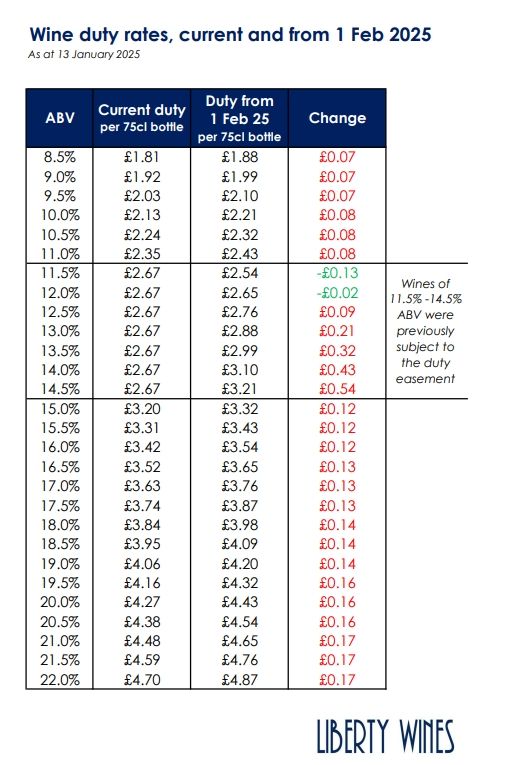
On 1 February, the “temporary easement” ends, and we transition entirely to a system based on ABV. Simultaneously, duty will increase by 3.65%.
Wines of 11.5% (-13p) and 12% (-2p) will see a slight duty fall as the easement ends, whereas those at 14.5% (+54p) or close to it (14% +43p, 13.5% +32p) will see notable duty increases.
The increases for wines outside of the 11.5%-14.5% easement band are most consistent, but note that a percentage increase means that the cash increase is smaller for lower ABV wines (e.g. +8p at 11% ABV) and larger at higher ABVs (e.g. +20p at 20% ABV).
We believe that good winemakers seek to reflect the nature of their grape varieties, vineyards and vintage. This means ABV will naturally vary. We do not think the duty system should penalise this variance. It encourages wine to be treated as a generic commodity, not a specific reflection of site. The new duty system is also more complex and, thus, more costly to administer.
Since the changes were announced, we have lobbied several MPs to encourage successive Governments to continue to tax wine by style, not ABV.