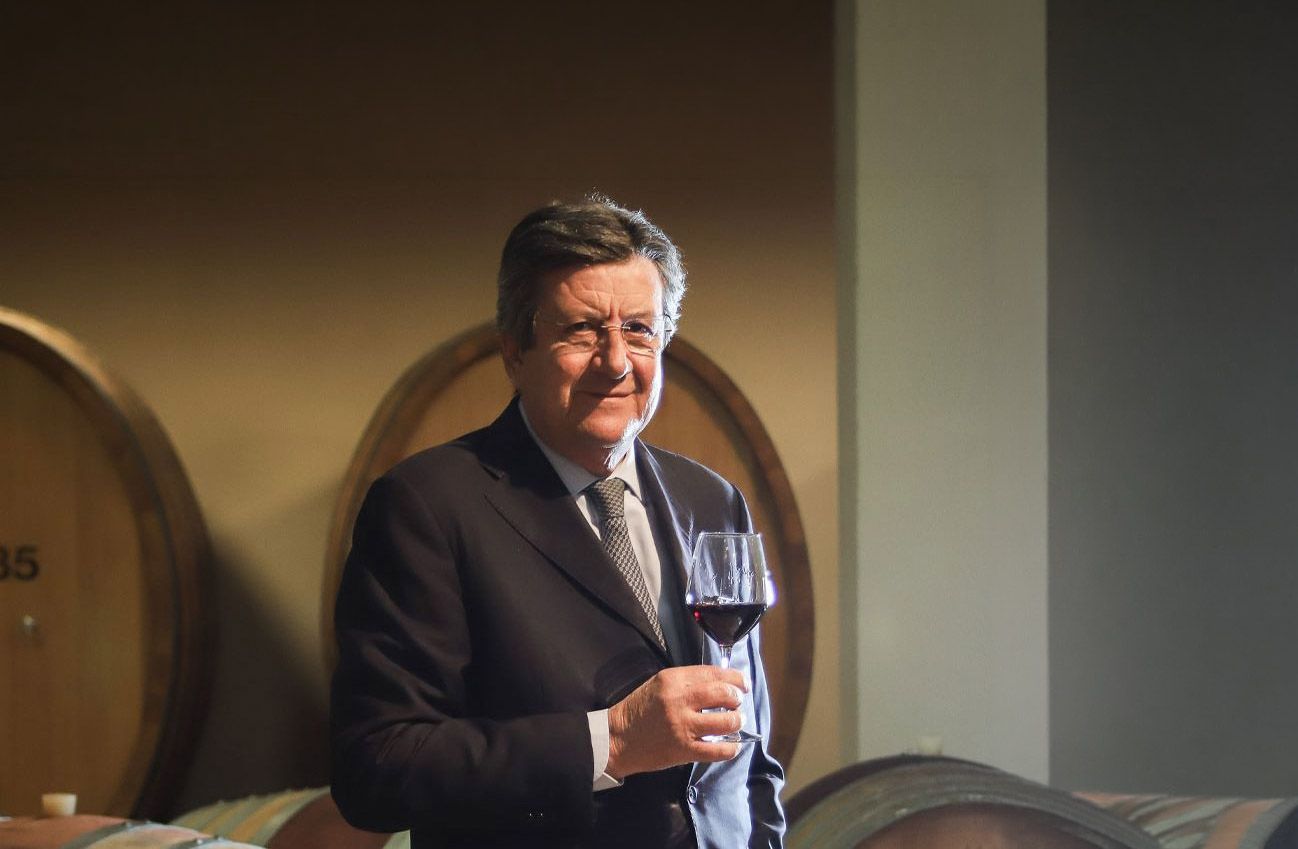
Franco Bernabei died last Thursday, 2 July, after losing his long battle with cancer.
He was the consultant winemaker at Selvapiana (since 1978), Fontodi (since 1980), Felsina (from 1983) and many other properties during a long career that had a huge influence over Tuscany’s move from Chianti in fiasco to the production of some of the world’s most outstanding wines.
He was born and raised in Padova in northeastern Italy, where his family had a wine distribution business, which for several decades now has been run by Franco’s brother, Paolo. Franco decided he wanted to make rather than distribute wines, so he moved to Tuscany in the mid-1970s to work for one of the big wineries of the time. In 1978, he struck out on his own as a consultant when he convinced Francesco Giuntini that he could help fulfil the qualitative aspirations he had for Selvapiana. The following year, in 1979, the first vintage of Bucerchiale, Selvapiana’s great single-vineyard wine, was produced.
In 1980, he started working with the 17-year-old Giovanni Manetti at Fontodi, with Flaccianello being produced for the first time in 1981. In 1983, his work with Giuseppe Mazzocolin of Felsina Berardenga saw the creation of the first vintages of Fontalloro and Rancia.
I met him for the first time in 1986, when I asked Paolo De Marchi to introduce us. I wanted to write something on the group that are today called the ‘tre vecchi’ – the three old men - which was comprised of Bernabei, Maurizio Castelli and Vittorio Fiore. They are the generation that followed in the footsteps of Giacomo Tachis (the creator of Tignanello, Sassicaia and Solaia, among other wines) and Giulio Gambelli, the palate behind Soldera and Monte Vertine.
The three young men built on the work done by Tachis and Gambelli to guide estate owners who’d been inspired by that new generation of wines from the 1970s. Fiore, the oldest, kept the lowest profile. “I will help you, but you need to make the wine and set the style,” he told a young Andrea Costanti in 1983. “It is your name, not mine, that is going to be on the label.” Castelli, who was the best known at that time, looked after properties like Volpaia in Chianti Classico and Castiglion del Bosco in Montalcino.
Bernabei appeared the most ambitious, even if he was the youngest of the three, born in 1952. He was always smartly dressed, his jacket and tie displaying the same sense of order that characterised the controlled approach of his winemaking. But there was no such thing as a ‘Bernabei style’. He worked with his producers to build a path out of the dark wood of Tuscan wine in the 1980s, building a state-of-the-art laboratory at his offices in Greve in Chianti where he constructed a library of analyses for all his producers.
“He was a great teacher,” says Federico Manetti of Selvapiana. “He worked with three generations at Selvapiana: my father and Francesco, me and my son Nicolo.” He was an outstanding taster. He tasted quickly and confidently, building a blend as he went through the samples. At the end of each tasting, he would pop outside for a cigarette.
His teaching meant he spent less time at Fontodi and Selvapiana as time went along, for the wines were made on site by the family. But they always met and tasted with Franco, and benefitted from his rigour. The relationship he had with his producers like Fontodi and Selvapiana developed into a deep and lasting friendship. On Friday of last week, one of them said to me that “we all feel like children again.”
The wines we see today are the fruit of that relationship. The 2023 Fontodi Chianti Classico is as good as the Flaccianello of the early 1980s, while the 2022 Bucerchiale is as good as any wine Selvapiana has ever made, perhaps with the exception of the 1985 vintage of the same wine.
I was in Italy when I heard the news on Thursday. When I returned home on Friday night, I opened a bottle of Selvapiana’s 2024 Chianti Rufina. Its pellucid, transparent fruit, unadorned by oak, is in its simplicity a perfect testament to the lesson Bernabei taught this fine estate, that no artifice is required to make wines of pleasure, and that your entry point wine should be what you build your reputation on.
What a legacy. Anyone buying or selling Italian wine today owes Franco Bernabei a huge debt.